TL:DR // Key Insights:
🧠💡©️➡️♾️📦💸⬇️ ➜ 🏆≠🔐✅ ➜ 🏆=🔎❓+🫥🧠+🆕🗣️ ➜ 🚫🤖📚
AI is rapidly commoditising codified knowledge, expertise and even intellectual property, so competitive advantage shifts away from owning answers toward the uniquely human capacity to discover the questions, tacit knowledge and new conceptual language that do not yet exist in the machine’s training data.
The practical implication is that organisations should stop treating AI primarily as an efficiency tool and instead build dense communities of learning, experimentation and knowledge-sharing where experienced people can surface hidden know-how, challenge established assumptions and continuously generate insights that AI can amplify—but competitors cannot simply copy.
🏢🚫🤖=⚙️💨 ➜ 🏢=👥🤝+🧪🔁+📚↔️+🧓🫥🧠➡️💡+🤔💥📏 ➜ 🤖📈💡 ➜ 🥇🔒🚫📋
Interesting times we live in. Who knew mathematics would ever become the most exciting topic in the world. Or would you have ever pictured it as the centre stage for one of the most significant intellectual battles of humankind where we are taking our last stance as human thinkers against an overwhelming force of machine intelligence? Yet, here we are, it’s 2026, and the most advanced AI models in the world are taking the lead on some of the last great mathematical questions of humankind, specifically the “Navier–Stokes Problem”. For everyone like me who is not a “native mathematician”: We are looking at a famous mathematical challenge asking whether a system of nonlinear partial differential equations (“Navier-Stokes Equations”) always have smooth solutions in three-dimensional Euclidean space.
Turns out that this famous mathematical challenge has very recently become the setting for a proper Shakespearean drama, staging not just the death of IP, but also of an overcome human creator economy.
But how so? Imagine that no less than 25 Fields medalists - the equivalent of getting a Nobel prize in mathematics - recently released a declaration of urgency stating “A Severe Misalignment of AI in Mathematics”. What’s really striking about this declaration is that - at its heart - it is not talking about maths at all. There are no mathematical models mentioned, not even any discussion about the latest Navier-Stokes proof proposed by OpenAI.
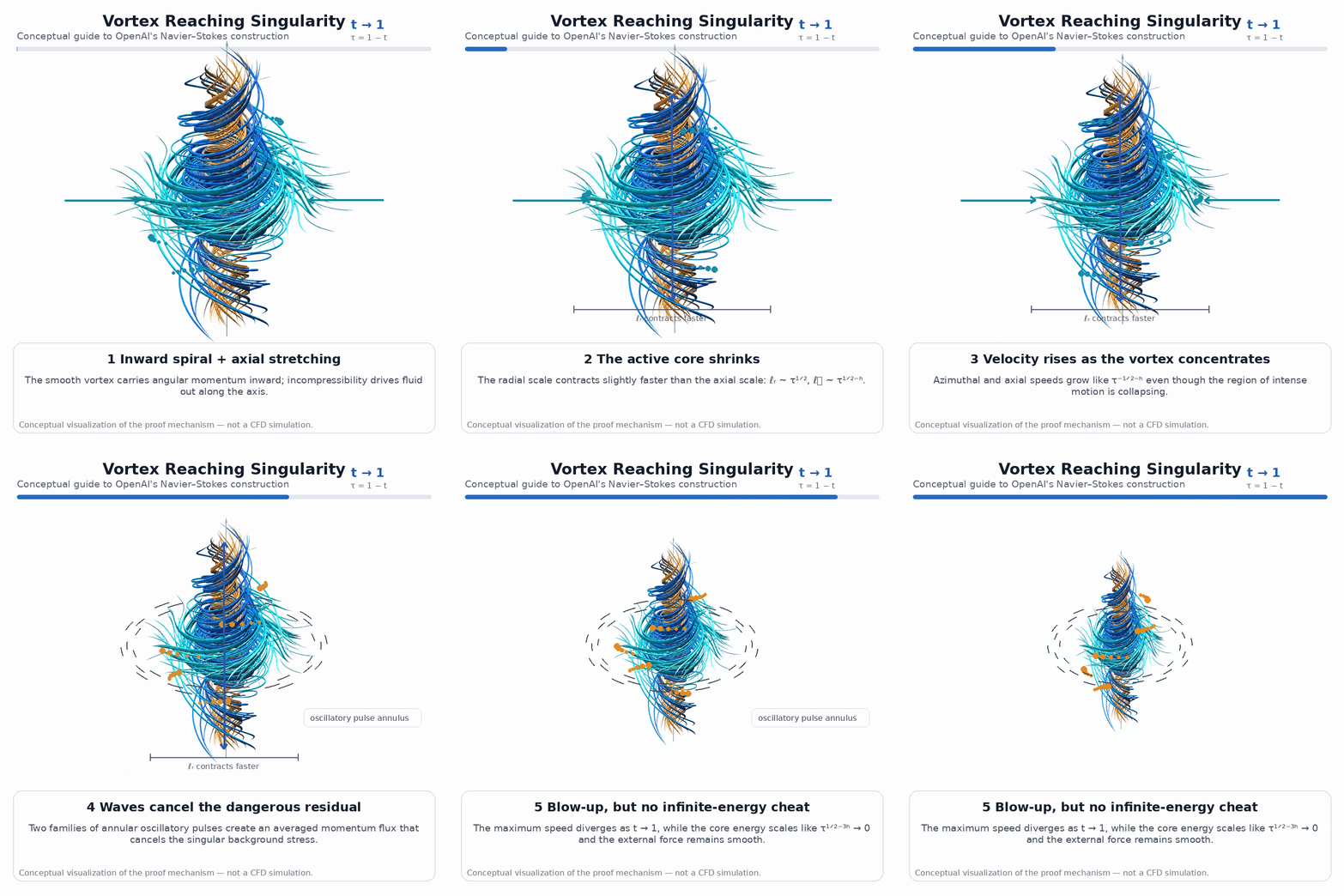
What the declaration instead stresses are the underlying conditions required for the creation of any meaningful human knowledge in the first place:
“The mathematical community functions, in many ways, as a miniature version of humanity. … solving problems is only a tool and proxy for achieving the primary goal of conceptual under- standing and insight. … The issues the mathematical community faces now are similar to issues that other scientific and creative professions are facing, and indicate issues that all of humanity might face: how to make sure that, as AI changes the way work is done, we do not lose sight of what that work was meant to achieve in the first place.”
Especially the dramatic ways in which OpenAI raced ahead to solve the problem by employing 10,000 concurrent AI agents working over 88 hours adds an interesting flavour to this drama of human vs. machine maths. And it of course also does not lack a special irony that it is mathematics of all disciplines lamenting over its own art of knowledge vectorisation turned against itself - by machines built to do just that at scale.
But what does that have to do with the rest of us, the ‘normal’ people doing ‘normal’ - not specifically mathematical - work? It basically shows in a nutshell what is about to happen with anything that can be expressed as a mathematical pattern - including any ever documented - even intellectually proprietary (IP) - knowledge: AI starts to not just ‘hoover’ up any new knowledge but it also commoditises it faster than any individual could ever internalise it.
At its core this demonstrates how AI is starting to wipe out our existing knowledge economies by dissolving the underlying fabric they were built upon: Traditional IP was designed to incentivise human creativity and technical breakthroughs by granting temporary monopolies. AI kills this concept by introducing immediate infinite production capabilities - rendering the whole idea of slow and ‘manual’ knowledge creation obsolete and simply structurally outpaced by machines. So anyone who wants to have a fighting chance to ‘win’ in the new game of AI-augmented problem solving is at risk of losing the essence of what led us to gain our current body of knowledge in the first place.
At the same time, good old IP also won’t be able to legally defend itself, because AI compresses and abstracts human IP into probabilistic data rather than making exact copies. This way it effectively ‘launders’ the value of original human work: AI consumes traditional IP as fuel, then outputs un-copyrightable content that directly competes with the original human creators. Through this ‘data & idea laundering’ the chain of custody between any individual creator’s ideas and the automated AI output is effectively broken.
Where does this leave us given we still need to differentiate ourselves in this new world of hyperabundant knowledge? How can we preserve our uniqueness against increasingly commoditised AI? Many will point to private AI, trained on proprietary data. Or to more aggressive trademarking to lock customers into branded UX. The problem is however that AI also ushered in the end of all things private and the beginning of a new age where any UX can be instantly copied in a few vibe coding sessions.
So the only actually sustainable solution is ironically pointing back to what made human discovery possible in the first place: Immersing ourselves into “a community that can invent new language to describe unforeseen problems”. Anyone wanting to make actual defensible progress against existing AI knowledge hence needs to move to the fringes, to the areas of actual discovery of new knowledge. Of course this requires “the absence of too much noise” to be able to encapsulate the tacit knowledge that lies beneath the commodified ‘taken-for- granted’ AI-knowledge most have already accepted as new reality. Who would have foreseen that some introverted mathematicians give us the ultimate clue to the survival of human intelligence: Human communities! This reinforces the idea that businesses will in future only be able to compete on ‘soft’ factors such as a culture of learning and innovation. It’s not by accident that most of the biggest AI companies in the world actively define themselves as ‘research firms’. The difference is ultimately just the culture and values bringing that research to life!